In an earlier blog piece (
"Old Dreams Born Anew") I briefly told the story of the mid-sixties band The Abstracts, and how they (we) had a totally unexpected "resurrection" of sorts.
This was brought about via an enthusiasm for the group by respected pop music historian Mike Dugo, who had in a real sense 'found me out,' thus allowing the group's rather interesting story to be told. And, again, in large part by his good graces, the band's long forgotten (well the band members had thought them so, anyhow) recordings to again get aired and be released on an LP and follow up CD.
Mike D. had tracked me down and asked for an "exclusive interview" to be published on his website, 60s Garagebands -- no longer, alas, available on the web. And the publishing of that interview, in turn, had led to a series of interviews with Wolfgang Völkel of Break-A-Way Records -- that as part of the company's project of remastering and releasing all of The Abstracts recordings, including the group's long thought lost Columbia sessions on an LP (and followup CD) entitled
"Hey, Let's Go Now!"
Included with the LP there was a large, 4 page, insert that told the band's history with both words and photographs. And now, some five years after its release, and with Mike Dugo's material no longer available on the web, I thought it was fitting to release some of the material that Break-A-Way's writers used to create that "authorized" history.
Note that the information presented below, written up by record producer Wolfgang Völkel, was based on his interview with me, based on my then over 45 years old memories. Before the official history was published these were filled out, and to some degree "adjusted," by the recollections of the band's drummer, Mike Machat, and also with thoughts shared by Andrew Bonime and others involved with the group "back when."
Perhaps, if there is interest, and if others are agreeable, some of those other recollections as recorded by Wolfgang Völkel can also be shared at a future time. -But even based just on these, my own, a pretty accurate picture is painted about the times and events involving the band The Abstracts. -An exciting time and interesting story for sure.
Well, it was for me and the others involved. I believe and hope that any readers of this piece, be it now or in the future, will find themselves agreeing.
-Don Sucher
Break-A-Way Records –
Break 026
Working Title: Abstracts/Hey, Let´s Go Now -
Vinyl LP
Subject: Band History
Interview with Don
Sucher
Don explained his and Al Karps’
way into RocknRoll already in the interview with Mike Dugo. What was the
musical background of the other bandmembers? Anyway who already played in a
rock ‘n’ roll band before? Or was the Abstracts everybody’s first band.
Don and Al had played in
several groups before The Abstracts including The BiTones and The Twi-lites,
Interestingly, while the music Don and Al performed in the later pre-Abstracts
groups was largely forgotten, several songs that they first arranged and played
together in the BiTones found their way into The Abstracts repertoire.
Andy Bonime played with
other musicians to develop his ‘chops’ (and his considerable writing/arranging
skills), but none actually, to my knowledge, came together as a named band.
Roger played with every
group of musicians he could find. One day when Don and Al were playing along
with a drummer friend on that person’s porch Roger, a complete stranger,
appeared and said “Can I get my bass and join you?” A short time later he was back and within a
half measure he was totally into the groove. He already knew every song they desired
to play.
1)
How old were the bandmembers by the time the first
lineup of the Abstracts got together in 1964?
Don, Al and Roger: 17; Mike and Andy
16,
2)
The basic influence of the band were Surf and Ventures
type instros – what effect did the Beatles resp the British Invasion have on
the band? Musically, fashionwise, personally
One cannot overstress
the importance of the Beatles and the other British Invasion groups. For The
Abstracts this had less to do with musical style -- The Abs only included a
relatively small number of Beatles songs in their extensive repertoire – but
the advent of the British Invasion totally changed what “being in a band”
meant. This was especially so for groups such as The Abstracts who determined
to create their own sound based on original compositions.
Teen style also totally
changed under the influence of the British groups. The “grease” look went out
and the long-haired ‘hip’ look came in. At the time this change seemed to be
organic, a simple reflection of “who we were,” but in hindsight there was a lot
of imitation.
One thing The Abstracts
never imitated however was the wild, drug-influenced, somewhat orgiastic life
style that some British Bands personified. Our focus always remained on the
music and the music alone.
3)
Your first recordings at Hempstead studios were
“Always Always” and “Gone Away”. That was still in 1964? Any more exact date
available? Was that already the “Always” version that later came out as the
B-Side of your 45 or did you re-record it along with “Baton Girl”?
I have reason to think the session
was held in May. I still believe that that recording session was the best of
any The Abstracts had. The reason? We were in total control. No one told us to
“turn down the amps and let us control the volume from the control room.” No
one was rushing us to meet a studio schedule (or a budget). That, along with
the excitement of the occasion, allowed us to be totally ourselves. And when
The Abstracts were “totally themselves” they rocked!
4)
How were things going at that studio? Can you describe
your first studio experience.
Beautifully. We set up.
We played. We listened. We made adjustments. We got what we wanted and then
moved on. Only two tracks, but those tracks were just what we intended them to
be. This is something I cannot say about any other studio session The Abstracts
had (or, for that matter, any of the later sessions I shared in working with
other bands).
5)
How did the invitation to the Columbia Recording
Session in early 1965 happen and what was the background of the labels activity
resp their plan with it?
There are contradictory answers to
this. Andy Bonime, who was often the moving and organizing force behind what
The Abstracts did, says he has no specific memory of how this session was set
up at all except that he remembers the involvement of noted Columbia Producer
Lor Crane. Mike and I, on the other hand, both remember the involvement of
Clive Davis. (In Mike’s case this includes a memory of a “scary” guy with a
stopwatch, sitting in the control room timing each cut, and than later seeing a
photo of the by then famous producer and thinking to himself “That’s the scary
guy with the stopwatch!”)
But when we tried to bring these
contradictory facts together Andy raised an interesting point: “I don't remember a single idea or suggestion coming from the booth.
This (is) one more reason I'm sure it wasn't Clive Davis.“ Frankly I find it hard to argue with that
reasoning.
So
in the end I guess this is, and will likely remain, an unknown. I know that
sounds hard to believe, but things were happening so fast for The Abstracts,
and the flow of event seemed to us then so natural – of course we have been
asked to record at Columbia!‘ – that names, dates and details were just lost in
the flow of unfolding events.
6)
Could you decribe and tell something about the
Columbia session. How long did it take, who was in charge of production, what
expectations did you have etc
None of us have many
memories of it at all. The ride up the freight elevator to Columbia’s famed
studios. Laying down the instrumental tracks. A break for a quick meal at our
favourite restaurant (Luigino’s on 42nd Street). Then back to the
studio for a (too) quick laying down of the vocals.
The strongest memory I
personally have was later… the ‘knife in the gut’, overwhelming disappointment,
that I experienced when I got a call telling me that The Abstracts were not
going to get the recording contract with Columbia we had set our heart’s on.
That that privilege was going to a West Coast band by the name of The Byrds.
But that memory, as strong and detailed as it is, is tied into my understanding
of what was involved in our getting the first session at Columbia – that Clive
Davis was fighting with Columbia to get that rather staid label to branch out
into Rock and Roll, and that he was got them to allow him to try out the idea
with one group. So it’d be The Byrds, not The Abstracts. (sigh)
Bottom line? Was it Clive
Davis? Or Lor Crane? Who knows? Who can know? It was all so very long ago.
7)
Your sole 45 was released after the Columbia Session.
You must have been in the studio again to record “Baton Girl”? Who brought you
to UP/Down Records? Did the label carry all costs, or did you pay for the
recordings and pressing? Who did the distribution? How many copies got pressed?
From Andy Bonime: “I don't remember any of these details, but that
session was paid for along with all distribution costs by Blanche Keslan who
owned the label and Keel Music, her publishing company.
8)
What made you decide to have Baton Girl as the A-Side
instead the (obviously to me) more typical Abstracts sound of “Always Always”?
Neither Mike, Andy nor I
have any fixed memory of how this decision was made.
I always felt that it
was a last ditch effort to get out a record. Baton Girl was a catchy song with
a “gimmick” – that of a marching-style snare drum overlaid on the rock and roll
drum beat. (Al Karp, interestingly, felt that that was its weakness) In any
case the quickie session produced a less than optimal master that did not
capture the essence or excitement of The Abstracts. When famous N.Y. radio disk
jockey Cousin Brucie – a big booster of The Abstracts – decided not to play it
on his program I knew it was cooked, and with it likely The Abstracts dreams of
nation-wide success.
And indeed that would
have been the case if it were not for the late Greg Shaw and his ineffable
ability to recognize and identify the lost gems of rock and roll. He obviously
at some point bought the Baton Girl single, flipped it over, listened to its
forgotten “b” side, and somehow saw it for what it was: The true sound of a
long lost and almost forgotten keystone `60s rock band.
Thanks largely to Greg,
and later to Mike Dugo of `60sGarageband.com, “Always Always” became a coveted
collector’s record. And then in some almost mysterious way fans of The
Abstracts started appearing and sharing their memories and enthusiasm.
It is almost as if all
this was meant to be.
9)
At what time would you say, the Abstracts were at
their peak of popularity? And how was the life as “an Abstract” at that time?
It started quickly and
intensely among a small but very dedicated group of fans during the summer of
`64, and then continued to build as we started to play a wider range of venues
– particularly our very popular “Abstracts in Concert” series.
I can best illustrate
what it was like for me by describing a scene that happened more than once – a
scene right out of the Beatles first film, A Hard Day’s Night.
I was living at my
parent’s home on Long Island but daily going into the city for classes at The
Film School, School of Visual Arts. I’d travel on the Long Island Railroad and my
train went through some towns where The Abstracts had a large fan base.
On more than a few
occasions, as the train made a scheduled stop in one of these towns, some young
female fans would see me on the stopped train and get almost hysterical. They’d
run up to the train and start beating on the glass screaming “Don Abstract! Don
Abstract!” This would continue as the train started to pull out of the station,
with the girls running alongside trying to keep up as the train picked up speed
until finally they’d fall behind, screaming all the while.
The staid businessmen
who shared my compartment would stare at me and at the girls in wonderment. I’d
just smile, shrug my shoulders, and quietly go back to my book. It was pretty amazing. Funny too!
10)
How about the management of the time? Did you have any
? How succesful was the Single?
On one occasion we had a
group of four men who took on managing and promoting us. I remember nothing
about them whatever except that it was they who set up a film shoot at a large
ornate hall in Brooklyn.
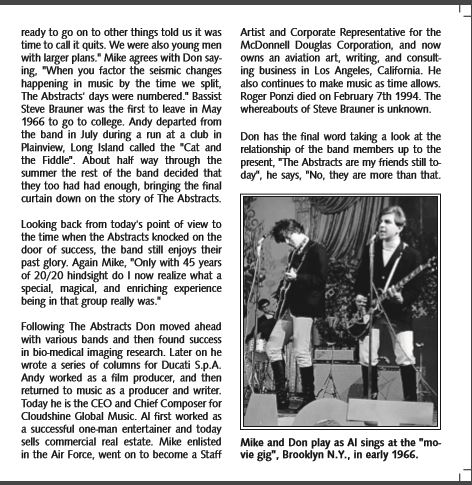
I have photographs of
that performance and you can see the camera and some recording gear. But
neither I, nor to my knowledge any member of the band, ever saw that film. (One
wag in the group even suggested that perhaps there had been no film in the
camera!) Who knows, maybe that film does exist somewhere to this day, covered
in dust, waiting to be discovered. Is that possible? Nothing concerning The
Abstracts surprises me any longer.
As to the single, we heard
that it was getting airplay in a few cities. I remember Philadelphia being
mentioned. But then… nothing. Well, except for Greg Shaw getting a copy,
flipping it over, and finding Always Always on the other side. Susie Shaw, Greg’s ex-wife, wrote me not long
ago that it was among their favourite tracks on the Essential Pebbles
collection. But who The Abstracts were remained a mystery even to them because
Greg, despite doing research about the band, was able to find nothing.
It was only after I
responded to a post on a YouTube video of the song – “Have you ever seen this
record” – and I very innocently answered “Yes, it is hanging framed on my wall,
I was a member of the group” that the “whos” “whens” and “wheres” questions
could be answered. Mike Dugo of `60GargeBand.com saw the opportunity, asked for
an interview, and, well, here we are.
11)
Why did it never come to a second 45?
Frankly The Abstracts
time was up. Musical styles were changing away from the simple, youth created
music that made the Abstracts (and so many of the better “Garage Bands”) what
they were, toward highly produced, more “professional” productions. Well that
and the fact that the members of the band were ready to go on to other things.
For while we were really, really
devoted to our music, we were also young men with larger plans. Plans, by the
way, that have to an amazing extent seen fulfilment.
12)
Practically all of your studio recordings is original
material. What kind of covers did you play live and what was an usual Abstracts
concert like? I hear fans crying their soul out on your live recordings.
Listening to tapes of
The Abstracts in Concert I am still amazed at the breadth and depth of our repertoire.
Of course there were the surf instrumentals such as the “Pipeline” cut recorded
at Columbia (That, btw, was recorded primarily to allow the sound guys to get a
feel for our instrumental sound balance and levels. If we really wanted to put something instrumental down on tape we likely
would done “Wipe Out” where Mike’s drumming was nothing less than breath
taking!), but also various then-popular favorites that fit our group style and
lots of classic “oldies” (even then!) some of which went back as far as Don and
Al alone together in their “Bi-Tones” days.
The Abstracts in Concert
was, more than anything, the thing that set the group apart. It was part
concert, part lecture series and part comedy show.
There were two versions,
each performed numerous times. The first told the story of rock and roll from
its earliest days through the music of its creators. Carl Perkins, Elvis
Presley, The Everly Brothers, and so forth.
The second iteration was
similar, but was divided into two parts corresponding with the two hour-long
“acts.” The first concentrated on the music’s American roots. The second jumped
the ocean and concentrated on the work of the British Invaders before focusing
on The Abstracts own originals.
Both iterations were
filled with the unexpected. Music from movies acted out on stage. (One young
lady almost got her head “chopped off” in an introduction to The Beatles song
“Help!”) TV commercials. Pie in the face
comedy. Children’s TV shows. Anything and everything was game.
And unusual for its
time, much of this was set to dramatic lighting effects. Something totally new
and totally different. Yes, fans screamed. For the band. And for more, more,
more!
13)
What kind of venues did you play at this stage. Where
did you play? What regions. How often? Weekends only? What other bands,
national or local acts, did you play with? Any TV appearance?
In the beginning we did all the
classic venues. The school ‘hops’, the “Sweet Sixteen” parties and the like.
But our real mettle came through best at the then (and perhaps still) totally
unique “Abstracts in Concert” series of two act, auditorium concerts designed
for a seated audience.
14)
Did you play professional at any time or did you still
go to highschool or university? If still at school, how did you get anything
under one hat?
My own feeling at the time was that
we were professional even when in high school and/or college. Practicing, arranging, recording and
especially performing was never a part time thing done when we happen to have
the chance. We were serious about it.
Indeed, amazingly so considering our age and circumstances. I never felt or saw
a conflict – even though I took my studies, especially at SVA, very
seriously. Chalk it up to youthful
energy I guess.
But that is not to say that all this
did not take a toll. The weeks leading up to the very first Abstracts in
Concert (on November 6th, 1964) were super intense. And the show itself
was draining beyond words. We put everything we had into it. The next morning I
woke up nearly delirious with a 104 degree (f) temperature.
15)
When about in 1966 did the Abstracts stop existing and
why did you split?
Simply put our time was up and we
were wise enough to know it. Several members were due to leave L.I. to attend
college in distant cities. The music scene itself was changing. And for me at
least other types of music beyond teen pop were sending out a siren call.
16)
Did you all
move into other bands or return to a “regular life”?
Is there a difference? ;-) I
personally moved ahead, first into a hard Chicago-style blues band, than into a
couple of bands devoted to my own original material, including a song I wrote
for a motion picture.
Eventually I made music making a
side line and devoted myself to a new found interest: devising specialized
imaging techniques for use in science and medicine. Then later yet I discovered
a latent talent as a writer and have penned, among other things, a series of
columns for Ducati S.p.A.
Andy left music for a time, had
quite a bit of success as a film producer, and then went back to music as a
producer and writer. He continues to create unique and wonderful music to this
day.
Al saw quite a bit of success as a
one-man entertainer after mastering the rare Guitarorgan. Today he sells
commercial real estate – no doubt with the same passion and success he devoted
to music.
Mike, even in his days with The
Abstracts, was producing amazing aviation art. Today his work hangs in places
like the Smithsonian Air and Space Museum and he is a much requested speaker,
as well as a respected author, on a wide range of aviation-related subjects. He
also continues to make music as time allows.
17)
Anything you wish to add that I should have asked but
forgot?
Two things…
First some words on what made up The
Abstract Sound.
Although The Abstracts clearly fit
in to the `60s musical scene and are by no means without influences, their
sound was surprisingly unique. This is even more clear to me today than it was
back then and becomes yet more so as I discover and rediscover the many
excellent bands that period of time produced.
Most `60s bands fall into one of a
few categories. They are “Beatles” bands, “Rolling Stones” bands, or, a bit
later, either organ based “Rascals” bands or San Francisco “psychedelic’ bands.
The Abstracts were none of those
things. How then would I describe their sound?
The Abstracts were pre-minimalist minimalists.
Where surf style threw in many
notes, largely drowning in reverb, the Abstracts used as few notes as possible
to support the music’s needs, and often kept even those distinctly staccato.
Guitar strings were often muted by the palm of the hand. Drum fills were
carefully chosen and always designed to move the music ahead. The beat was
steady, pointed and direct. And the bass and drums were far more than the
typical ‘producers of the beat,’ they were part and parcel to the very design
of the song.
Many people were amazed (and I might
add, disappointed) that the Abstracts did not include Always Always among the
songs they recorded for Columbia. This was by conscious choice because that
song -- as intrinsically “Abstracts” as it is -- did not have what we had come
to call “The Abstracts Beat” – a unique style of playing Mike and Roger
developed together that became a staple of most of our later original music.
The second point I’d like to make is
simply this:
THANK YOU WOLFGANG…for making this
LP a reality.
This from we in The Abstracts, and from
our many fans, old and new.
18)
What are the band members doing today?
See 16 above.
19) Finally, looking back
at it all what are your thoughts and feelings about this time now?
I sometimes look at the flow of my life and pinch myself. This has to be
a dream right? If I wake up it will be – it will have to be – a mere myst. A
dream far too wonderful to be true.
The Abstracts are an essential part of that.
Even apart from the excitement, the cheering audiences, the amazing
memories of comradeship and professional co-creation, there is something
greater. The influences of Andy, Al, Mike and Roger have made me the man I am
today and have, to large measure, given me the life I enjoy today.
From them I learned to dream large, and that a life can be as big as a
person’s dreams.
From them I learned for the first time the real meaning of friendship.
When I turn on a tape (and soon the coming LP) of The Abstracts, I find
I still connect to the music. It is essential. It is alive. And it is a
reflection of some of the most amazing people I have ever, even to this day,
had the pleasure to know.
The Abstracts are my friends.
No, they are more than that. They are my brothers.